TIWARI, SHUBHAM (2025) Patterns of Connectivity in Ecogeomorphic Systems: A Network-Based Approach to Understanding Land Degradation in Drylands. Doctoral thesis, Durham University.
![[img]](/style/images/fileicons/application_pdf.png)
| PDF - Accepted Version 123Mb |
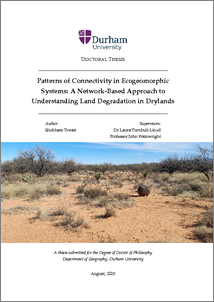
Abstract
Dryland ecosystems cover approximately 40% of Earth’s land surface and sustain over 2.7 billion people, yet they are highly vulnerable to irreversible transitions from grasslands to shrublands. Conventional monitoring captures static vegetation states, missing the reorganisation of resource flows. This thesis develops a network-science framework to reframe degradation as a measurable reconfiguration of landscape connectivity. The analysis is grounded in grassland to shrubland transitions in the drylands of the southwestern United States. Landscapes are represented as directed, weighted graphs that integrate structural (potential for movement) and functional connectivity (realised flux of water and sediment). Using high-resolution data, numerical modelling and networks, the framework tracks connectivity under changes in rainfall, antecedent soil moisture, aridity, grazing and wind. A set of interpretable network metrics link processes to patterns. Applied to contrasting vegetation states, the analysis shows that degradation is strongly scale dependent. Local-scale connectivity increases by approximately tenfold yet changes in whole-plot metrics remain modest. This local-global scale contrast obscures emerging degradation risk when assessed at coarse resolution. A central finding is that changes in water and nitrogen connectivity detect systemic reorganisation four to eight years before conventional vegetation metrics register decline. Because these indicators measure the processes that drive transitions rather than their symptoms, they are robust across scales and climate regimes. The thesis translates connectivity insights into management by applying network-derived indicators in adaptive grazing simulations. Strategies that manage flows, rather than stocks, maintain substantially higher grass biomass under intensive pressure (up to 47× relative to conventional rules). This yields threshold-based rules that stabilise grasslands and prevent transition to shrubland. The work provides a transferable workflow for quantifying structural and functional connectivity. It demonstrates that dryland regime shifts are preceded by predictable network rewiring, offering a pathway from model to management that proposes to operationalise connectivity for proactive management of drylands.
| Item Type: | Thesis (Doctoral) |
|---|---|
| Award: | Doctor of Philosophy |
| Keywords: | Land Degradation; Connectivity; Dryland Ecosystem; Network Analysis; Early Warning Signal; Adaptive Grazing |
| Faculty and Department: | Faculty of Social Sciences and Health > Geography, Department of |
| Thesis Date: | 2025 |
| Copyright: | Copyright of this thesis is held by the author |
| Deposited On: | 10 Dec 2025 08:18 |
Social bookmarking: