SILVA, KRISHNA,MILANI,SIMOES (2025) The implications of subsurface CO2 geological storage for mineralogy, petrophysics and geomechanical behaviour: Triassic Sherwood Sandstone, East Irish Sea, UK. Masters thesis, Durham University.
![[img]](/style/images/fileicons/application_pdf.png)
| PDF (Implications of subsurface CO2 geological storage for a reservoir rock) - Accepted Version 213Mb |
Abstract
Mineralogical alterations and their consequences for rock geomechanical behavior and petrophysical parameters may occur during CO2 geological storage-CGS due to the acidic character of pore fluids.
In this study, we have undertaken an integrated method through hydrothermal
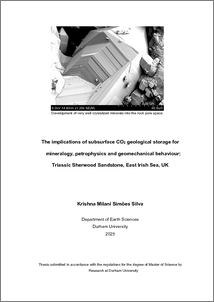
experiments, petrophysical measurements and triaxial tests to assess the impacts of CO2 storage by comparing the pre- and post-reacted samples in terms of mineralogy, petrophysics and geomechanics of rock samples from the Sherwood Sandstone Group, East Irish Sea, UK. These Triassic samples are subarkosic arenites made up mainly of quartz, feldspars, lithic fragments, carbonate cement, K-clay and accessory minerals which were determined using optical and scanning electron microscopy-SEM. Detailed SEM images and SEM-EDS mapping illustrate carbonate cement, partial alteration of feldspars and clay coating grains. The bulk density and total porosity of the pre-reacted samples vary between 2.27-2.38g/cc (± 0.02 g/cc) and 10.7-14.7.5% (± 0.1 %) respectively. The confined permeabilities are within the order of e-14m2. The Young’s Moduli and peak stress obtained for two pre-reacted samples were 11.7GPa/108MPa and 16GPa/125MPa (± 0.1 GPa and ± 1 MPa).
Three hydrothermal experiments were carried out at temperatures between 50°
-130°C and pressurized at 10 and 50 bars. In each experiment, the Triassic sandstone core was submerged in a seawater-like fluid, the autoclave was closed and then pressurized with CO2 injected into the head space. The remaining fluid was collected and then analysed for key chemical species using ICP-OES.
Carbonate dissolution, increase of the K-feldspar and lithic fragments alteration
degree in the hydrothermal reacted samples were observed leading to the modification of pore space. Fluid analysis reinforces both carbonate and silicates dissolution.
Considering mineral dissolution as the main rock alteration process, increase in total and effective porosities and permeability were observed. Conversely, the bulk density and velocity measurements presented smaller values.
No rock weakening was determined since the Young's Moduli and peak stress of reacted samples were within the range of unreacted ones.
The results presented can be used to better understand the storage capacity, injectivity and safety of CGS projects.
| Item Type: | Thesis (Masters) |
|---|---|
| Award: | Master of Science |
| Keywords: | CO2, CCS, geochemistry, geomechanics, petrophysics |
| Faculty and Department: | Faculty of Science > Earth Sciences, Department of |
| Thesis Date: | 2025 |
| Copyright: | Copyright of this thesis is held by the author |
| Deposited On: | 10 Dec 2025 07:52 |
Social bookmarking: