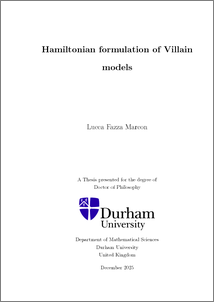
FAZZA MARCON, LUCCA (2025) Hamiltonian formulation of Villain models. Doctoral thesis, Durham University.
![[img]](/style/images/fileicons/application_pdf.png)
| PDF - Accepted Version 1785Kb |
Abstract
Lattice formulations provide essential non-perturbative access to strongly coupled QFTs but often break fundamental continuum symmetries. This violation, particularly concerning topological currents, introduces unphysical artifacts like dynamical vortices or monopoles. This work employs the Villain Hamiltonian framework—using integer-valued auxiliary fields—to systematically restore these symmetries in lattice compact scalar and gauge theories. We apply this to compact U(1) gauge theories in 2D and 3D, demonstrating its ability to enforce microscopic Gauss’s law, eliminate spurious topological defects, and replicate continuum symmetry structures. In 3D, the framework yields a natural operator-level electric-magnetic duality. Crucially, we construct fracton-inspired constrained models by coupling compact plaquette variables to higher-form gauge fields, which enforce exact higher-moment conservation laws. A key advance establishes an exact duality between one such fraton model and a transverse-field Ising model with extended interactions. Exploiting this fracton-Ising duality, we perform large-scale Monte Carlo simulations on the dual Ising model to study the fracton model’s phase structure. Finite-size scaling provides numerical evidence for a continuous phase transition at a critical coupling, offering new insights into exotic quantum system dynamics. This establishes the Villain Hamiltonian as a powerful tool for capturing topological symmetries and enabling precise lattice studies of confinement, duality, and constrained phenomena.
| Item Type: | Thesis (Doctoral) |
|---|---|
| Award: | Doctor of Philosophy |
| Faculty and Department: | Faculty of Science > Mathematical Sciences, Department of |
| Thesis Date: | 2025 |
| Copyright: | Copyright of this thesis is held by the author |
| Deposited On: | 17 Dec 2025 09:19 |
Social bookmarking: