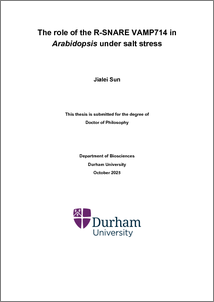
SUN, JIALEI (2025) The role of the R-SNARE VAMP714 in Arabidopsis under salt stress. Doctoral thesis, Durham University.
![[img]](/style/images/fileicons/application_pdf.png)
| PDF 22Mb |
Abstract
PIN-FORMED (PIN) proteins mediate the polar transport of auxin and require vesicle trafficking for their localisation and abundance at the plasma membrane. The work described in this thesis investigates the hypothesised role of the PIN trafficking component VAMP714, an R-SNARE, in these processes under salt stress, a stress with known auxin-mediated effects on root development.
Salt stress induced VAMP714 transcription and altered its protein localisation from membrane-associated vesicles to diffuse cytosolic pools. At the same time, auxin responses became restricted to the root cap and PIN polarity was progressively lost. Native-promoter overexpression of VAMP714 maintained root elongation and restricted lateral root proliferation under salinity, whereas constitutive overexpression and knockout lines did not, indicating dosage sensitivity. Tolerance depended on polar auxin transport.
Protein–protein interaction assays identified CTL1 as a partner of VAMP714 at trans-Golgi and early endosomal compartments. CTL1 was required for VAMP714 distribution and for PIN1, but not for PIN2, polarity. Salt stress induced CTL1 expression in roots, and exogenous choline modified a root-specific CTL1–VAMP714 regulatory loop, suggesting a lipid–SNARE module controlling auxin-carrier trafficking.
Transcriptome analysis of vamp714 mutants revealed early changes in redox and vesicle trafficking genes, with CYP96A12 emerging as a candidate regulator. Protein interaction networks highlighted AP-3, SNAP29, SYP23, and MEMB11 as dynamic partners. ROS assays showed enhanced H₂O₂ accumulation in mutants, with compensatory catalase activity, indicating a role for VAMP714 in ROS compartmentalisation. Additionally, VAMP714 may be involved in, or associated with, the SOS-mediated response to salt stress under the conditions examined in this study.
Ionomic analysis showed that salt increased Na⁺ concentrations and destabilised K⁺ and Ca²⁺ homeostasis in both wild type and mutants. Auxin treatments did not restore ionic balance but elevated Ca²⁺ independently of VAMP714. Inhibition of YUCCA-mediated auxin biosynthesis impaired ionic regulation in a VAMP714-dependent manner, while exogenous Ca²⁺ partially rescued growth through a parallel pathway.
Together, these findings establish VAMP714 as a stress-inducible trafficking regulator that safeguards PIN polarity, shapes redox dynamics, and connects auxin signalling with SOS-dependent ion homeostasis during early salt adaptation.
| Item Type: | Thesis (Doctoral) |
|---|---|
| Award: | Doctor of Philosophy |
| Faculty and Department: | Faculty of Science > Biological and Biomedical Sciences, School of |
| Thesis Date: | 2025 |
| Copyright: | Copyright of this thesis is held by the author |
| Deposited On: | 17 Dec 2025 09:07 |
Social bookmarking: