KRUSE, ELAINE (2025) Dyslexia and Entrepreneurship: Exploring How Early Adversity, Coping Strategies, and Self-Efficacy Shape the Entrepreneurial Journeys of Individuals with Dyslexia. Doctoral thesis, Durham University.
![[img]](/style/images/fileicons/application_pdf.png)
| PDF 2776Kb |
Abstract
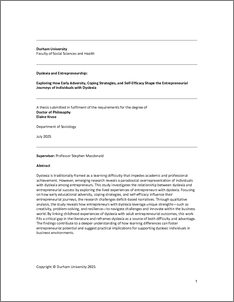
Dyslexia is traditionally framed as a learning difficulty that impedes academic and professional achievement. However, emerging research reveals a paradoxical overrepresentation of individuals with dyslexia among entrepreneurs. This study investigates the relationship between dyslexia and entrepreneurial success by exploring the lived experiences of entrepreneurs with dyslexia. Focusing on how early educational adversity, coping strategies, and self-efficacy influence their entrepreneurial journeys, the research challenges deficit-based narratives. Through qualitative analysis, the study reveals how entrepreneurs with dyslexia leverage unique strengths—such as creativity, problem-solving, and resilience—to navigate challenges and innovate within the business world. By linking childhood experiences of dyslexia with adult entrepreneurial outcomes, this work fills a critical gap in the literature and reframes dyslexia as a source of both difficulty and advantage. The findings contribute to a deeper understanding of how learning differences can foster entrepreneurial potential and suggest practical implications for supporting dyslexic individuals in business environments.
| Item Type: | Thesis (Doctoral) |
|---|---|
| Award: | Doctor of Philosophy |
| Keywords: | Dyslexia; Entrepreneurship; Self-Efficacy |
| Faculty and Department: | Faculty of Social Sciences and Health > Applied Social Sciences, School of |
| Thesis Date: | 2025 |
| Copyright: | Copyright of this thesis is held by the author |
| Deposited On: | 24 Nov 2025 11:33 |
Social bookmarking: